A Hello Kitty ROM-hack of Dig Dug
The 1990s were the peak of cartridge piracy in Asia, and Hello Kitty inevitably turned up in it. The documented record is smaller than the legend: one well-attested ROM-hack of Namco’s Dig Dug, the Chinese multicarts that carried it, and a famous bootleg that almost certainly never existed. Everything beyond that circulates on repetition rather than evidence.
Context
Almost everything official was Japan-only
Almost every 1990s Sanrio game was a Japan-only licensed title from Sanrio’s subsidiary Character Soft (plus Imagineer, with rare Western releases via NewKidCo and Ubi Soft). That matters here, because it is the licensed backdrop against which a small number of genuine bootlegs stand out.
What is documented
The documented carts
Two entries are well sourced. Both are sprite-swaps, and the makers of neither are known.
Hello Kitty (a.k.a. "Kitty")
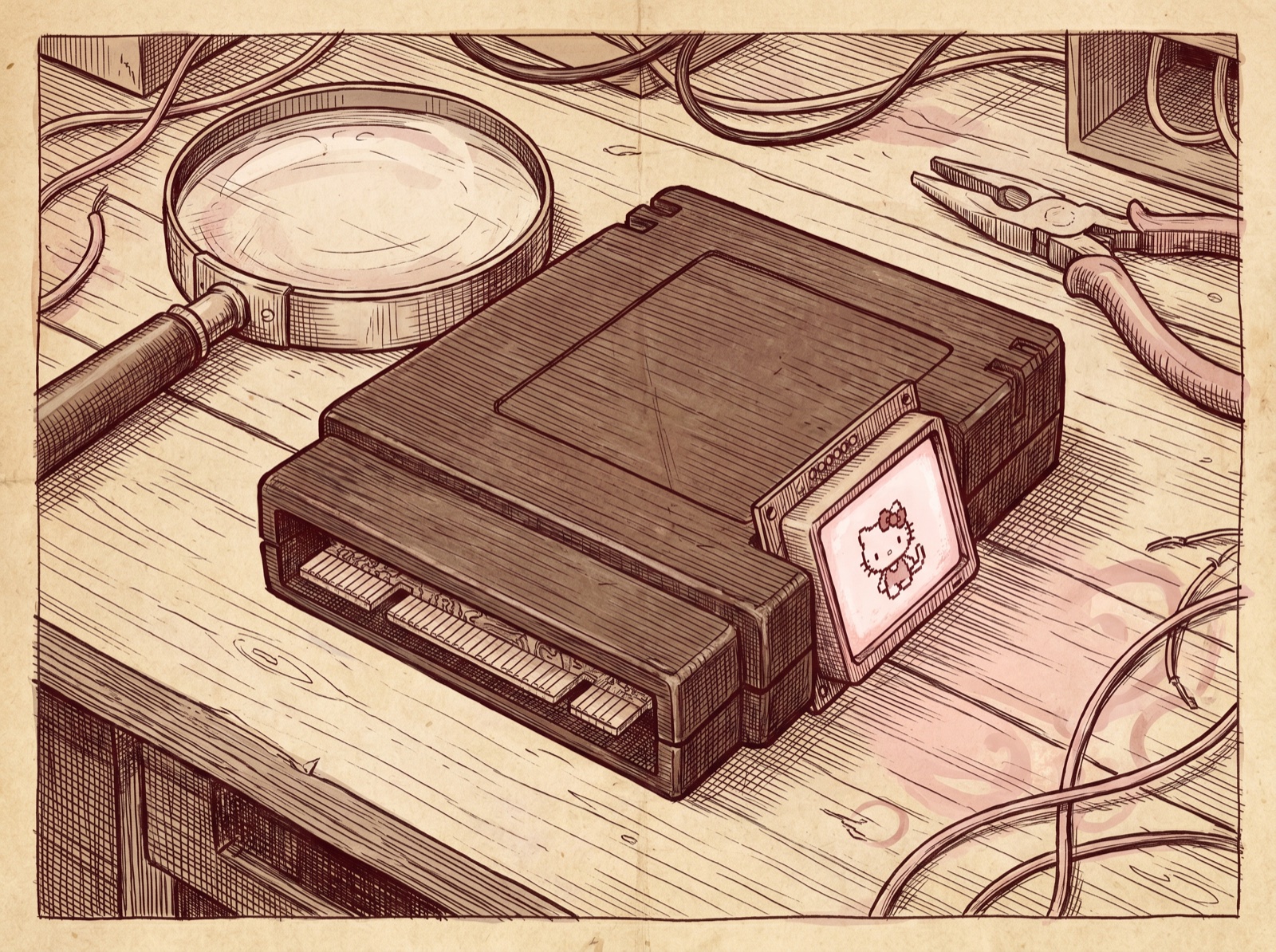
BootlegThe primary documented unlicensed Sanrio Famicom title. It is an unlicensed ROM-hack of the Famicom version of Dig Dug: the player sprite is replaced with Hello Kitty and the title screen is blacked out. Per BootlegGames Wiki it was "initially released for Y2K-series multicarts," appears "mostly on various Chinese Famicom multicarts," and shows up on a few dedicated single carts. Her dress was rendered blue in early versions and corrected to pink in later revisions.
Confidence: The hack’s existence is well attested (three sources). The blue-to-pink detail and exact cart list are community-sourced (medium confidence). Origin and author are unknown, and the date is only roughly Y2K-era. Do not attribute it.
Keroppi to Keroleen no Splash Bomb (re-hacked)
BootlegThe reverse case. Under BootlegGames Wiki’s "Mario Pirate Hacks," this legitimate Sanrio title was itself hacked: Keroppi was replaced with Luigi (using Yoshi’s Cookie graphics), with a broken English title. It shows that licensed Sanrio carts circulated on pirate multicarts and were themselves re-hacked.
The Super Mario bootleg
Do not repeat the "Hello Kitty Super Mario bootleg" meme as fact. No documented Hello Kitty hack of Super Mario was found. The verified base game for the famous Hello Kitty Famicom bootleg is Dig Dug, not Mario. Treat any "Hello Kitty Mario" claim as unconfirmed.
The hardware
Multicarts and Famiclones
The Hello Kitty hack spread on the Chinese many-in-one cartridge trade and the gray-market clone consoles built to play it.
Y2K 64-in-1 and the "Y2K-series" multicarts
Chinese many-in-1 Famicom carts, the recurring vehicle for the Hello Kitty / Dig Dug hack.
Power Joy Classic TV Game
An unlicensed Famiclone console by Trump Grand (sold in the UK and North America around 2001). Its built-in "Finger DDR" reportedly contains unused Pikachu and Hello Kitty graphics: Sanrio art embedded in pirate hardware, not a playable game.
Single wiki source (medium-low confidence).
Why it happened
No lockout chip, and many factories
- The Famicom had no lockout chip, which enabled rampant unauthorized cartridge production across Asia.
- Taiwan’s NTDEC ("Nintendo Electronic Co.") was a notorious early-1990s Famicom pirate and Nintendo-trademark abuser; employee arrests and roughly 1993 legal action ended the NTDEC name.
- Hong Kong cartridge makers and mainland multicart and Famiclone factories (such as Trump Grand) dominated later production. Hack groups associated with the "Y2K" carts produced the sprite-swaps.
Enforcement
No documented enforcement
No documented Sanrio-specific enforcement against the Hello Kitty / Dig Dug hack or these multicarts was found. Sanrio’s known anti-counterfeit activity is modern and merchandise-focused, not retro-cart-focused. Nintendo’s enforcement in this era was general (the Seal of Quality, the NTDEC action, cooperation with Chinese authorities), not Sanrio-linked.
Sources of record
- BootlegGames Wiki — Hello Kitty (Dig Dug hack) [community catalog]
- The Spriters Resource — Y2K 64-in-1 (Bootleg) ROM rip
- BootlegGames Wiki — Mario Pirate Hacks (Keroppi to Luigi)
- BootlegGames Wiki — Power Joy Classic TV Game
- Wikipedia — Famiclone (no lockout chip)
- Wikipedia — NTDEC
- Wikipedia — IP protection by Nintendo